Our View: Time for drone policy in U.S. to take flight

Unmanned aircraft, once reserved for clandestine military operations, are now everywhere. These drones, fixed with high-definition cameras, are used to record video, survey crops and wind farms, herd livestock and conduct search-and-rescue operations. Some day, drones could be used to deliver goods, everything from pizza and beer to socks and shoes.

But while the technology steadily improves, and falls in price, regulation in the United States lags behind. The Federal Aviation Administration has missed several deadlines for proposing new rules on drones, and now those rules are not likely to be finalized until “2017 or later,” according to the Government Accountability Office.

Additional Images
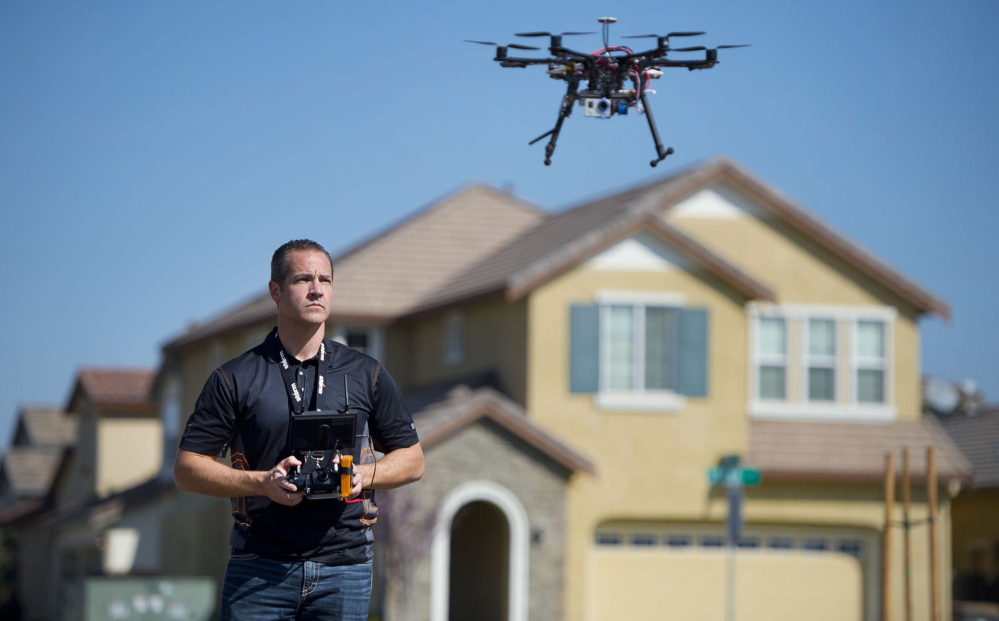
A real estate agent uses a helicopter drone to take video of a Sacramento, Calif., home. An FAA ban on the commercial use of drones is hard to enforce.

That is much too long a delay for devices that are fast becoming common despite the restrictions now in place, and for which a huge international market exists that is quickly leaving U.S. companies behind.

For now, the commercial use of drones is prohibited by FAA policy, except in the extremely rare cases when the FAA has allowed them to be used in filmmaking.

Hobbyists who use drones for their own enjoyment are governed by the same regulations that cover model airplanes, which must be kept under 400 feet in altitude, away from aircraft and airports and within sight of the user.

The FAA regulations haven’t stopped the use of drones, however; they’ve just pushed it under the radar, so

Article source: http://www.pressherald.com/2015/01/06/our-view-time-for-drone-policy-in-u-s-to-take-flight/

Posted in Model Airpanes | Tagged , | Leave a comment

Butler National Selling New Learjet Component Solutions


OLATHE, Kan., Jan. 6, 2015 /PRNewswire/ — Butler National Corporation (OTC Pink: BUKS), a leading manufacturer and provider of support systems for commercial and military aircraft and a recognized provider of management services in diverse business groups including the gaming industry, announces the availability of two new component solutions for sale for Learjets.

Incorporating new technologies, Butler National designed, manufactured and obtained Federal Aviation Administration Supplemental Type Certificate (STC) approval of a replacement rate sensor for use by the autopilot on the roll axis and yaw axis of the applicable Learjet 31/35/35A/36/36A/C-21A and 55 Series airplanes, and on the yaw axis on the Learjet Model 24/25/28/29 Series airplanes.  The replacement rate gyro sensor is approved for installation under STC number ST02416SE.  The new rate gyros are available for immediate sale and shipment.

Butler National also added another new STC to replace the existing stall warning accelerometer for the Learjet 24/25/28/29 Series airplanes and Learjet 35/35A/36/36A airplanes with the FC-200 autopilot.  The new vertical accelerometer is STC (STC number ST02417SE) approved as an alternate means of compliance for airworthiness directive 82-01-05.  The new vertical accelerometer is currently available for sale and shipment from Butler National.

Parts obsolescence is a never ending battle in the airplane business. 

Article source: http://www.prnewswire.com/news-releases/butler-national-selling-new-learjet-component-solutions-300016423.html

Posted in Model Airpanes | Tagged | Leave a comment

Annoying Airport Delays Might Prevent You From Becoming the Next AirAsia 8501

Next time you find yourself fuming over a three-hour ground hold at the airport, and the consequent snowball of flight delays and cancellations, get over it: you should be grateful for the fact that this is part of an aviation safety regime that works. That ground hold was to stop you flying through weather that could kill you and everyone else aboard.

These days weather should never cause a commercial airliner to crash. That’s why increased scrutiny is being given to what brought down AirAsia Flight 8501 over the Java Sea. The pilots of the Airbus A320 flew into a powerful storm. Were they really aware of how dangerous it was?

The accident rate in Asia has marred what was in 2014 a banner year for aviation safety. The estimated number of flights worldwide was 33 million. There were only 21 fatal crashes, the fewest ever. But because the fatal crashes included several involving large wide-body airliners, the total number of deaths, 990, pulled down the ranking in fatalities to the worst for 24 years. The disappearance of Malaysian Airlines Flight 370 and the loss of AirAsia 8501, both in Asian airspace, gives the region an unhappy prominence.

Meanwhile, the management of U. S. airspace is exemplary. There were no deaths on scheduled commercial aviation flights in 2014, in a system that operates 68,000 flights a day.

The AirAsia crash raises urgent questions about the management of Indonesian airspace. Specifically, what briefing did the flight crew receive before they went to the

Article source: http://www.thedailybeast.com/articles/2015/01/06/annoying-airport-delays-might-prevent-you-from-becoming-the-next-airasia-8501.html

Posted in Model Airpanes | Tagged , | Leave a comment

3D Printing RC Airplanes that Fly: An Engineer’s Chronicle

In the past, creating accurate replicas of models and fantasy objects was a task left to the most talented of cosplayers. These props need not be functional, though. [Steve Johnstone] takes replica model-building to the next step. He’s designing and building a model airplane that flies, and he’s documenting every step of the way.

Armed with a variety of 3D printing techniques and years of model-building experience, [Steve] is taking the lid off a number of previously undocumented techniques, many of which are especially relevant to the model-builder equipped with a 3D printer in the workshop.

As he continues his video log, [Steve] takes you through each detail, evaluating the quality of both his tools and techniques. How does a Makerbot, a Formlabs, and a Shapeways print stand up against being used in the target application? [Steve] evaluates a number of his turbine prints with a rigorous variable-controlled test setup.

How can we predict the plane’s center-of-gravity before committing to a physical design? [Steve] discusses related design decisions with an in-depth exploration of his CAD design, modeled down to the battery-pack wires. Though he’s not entirely finished, [Steve’s] work serves as a great chance to “dive into the mind of the engineer,” a rare opportunity when we usually discover a project after it’s been sealed from the outside.

3D printing functional parts with hobbyist-grade printers is still a

Article source: http://hackaday.com/2015/01/05/3d-printing-rc-airplanes-that-fly-an-engineers-chronicle/

Posted in Model Airpanes | Tagged | Leave a comment

OUR OPINION: Time for drone policy in US to take flight

Unmanned aircraft, once reserved for clandestine military operations, are now everywhere. These drones, fixed with high-definition cameras, are used to record video, survey crops and wind farms, herd livestock and conduct search-and-rescue operations. Some day, drones could be used to deliver goods, everything from pizza and beer to socks and shoes.

But while the technology steadily improves, and falls in price, regulation in the United States lags behind. The Federal Aviation Administration has missed several deadlines for proposing new rules on drones, and now those rules are not likely to be finalized until “2017 or later,” according to the Government Accountability Office.

That is much too long a delay for devices that are fast becoming common despite the restrictions now in place, and for which a huge international market exists that is quickly leaving U.S. companies behind.

For now, the commercial use of drones is prohibited by FAA policy, except in the extremely rare cases the FAA has allowed them to be used in filmmaking. Hobbyists who use drones for their own enjoyment are governed by the same regulations that cover model airplanes, which must be kept under 400 feet in altitude, away from aircraft and airports, and within sight of the user.

That hasn’t stopped the use of drones, however; it’s just pushed it under the radar, so to speak.

The FAA, which is busy regulating manned aircraft, has little time and few resources for tracking commercial use of drones. In fact, in the 13 months preceding July 2013, the FAA conducted

Article source: http://www.centralmaine.com/2015/01/06/our-opinion-time-for-drone-policy-in-us-to-take-flight/

Posted in Model Airpanes | Tagged , | Leave a comment

Why scavenging through other people’s trash isn’t a bad thing

Local News

State Parks superintendent is named SLO County’s parks director

Article source: http://www.sanluisobispo.com/2015/01/05/3427679/why-scavenging-through-other-peoples.html

Posted in Model Airpanes | Tagged | Leave a comment

Satellite tracking

Highlands Museum and Morehead State University team up for new space exhibit

ASHLAND — What used to be an area used for storage in the Highlands Museum and Discovery Center has turned into the recently opened “Satellites, Aerospace and the Bluegrass State” exhibit designed and built by the Morehead State University Space Science Program.

“This exhibit will help visitors gain a better understanding of where satellites are in earth’s orbit and how that relates to their function,” Eric Thomas, director of MSU’s Star Theatre, staff member of the university’s Space Science Program and designer of the exhibit, said. “It will also let visitors learn about the process of building satellites, gain a better understanding of the role of ground operations in satellite management and more about MSU’s space science programs overall.”

The Highlands Museum and MSU teamed up to be able to make this exhibit possible.

“It was so cool to meet and work with the people that build satellites,” Emily Roush, educational and marketing director at the museum, said.

The exhibit features diagrams, pictures and information, a video game that tests the ability to keep a satellite in orbit and 1:1 scale models of satellites built and flown by MSU.

“A lot of people think of satellites as these giant machines in outer space,” Roush said. “But to see a 1:1 scale model is eye opening. People don’t realize that aerospace parts are built right in our backyard, not just at MSU, but all over the state of Kentucky.”

As of now, the museum hosts a

Article source: http://www.irontontribune.com/2015/01/05/satellite-tracking/

Posted in Model Airpanes | Tagged | Leave a comment