DTN 5_19_2019
View this issue
Browse previous issues
Article source: http://daily-tribune.com/stories/gary-james-riddle,22193
View this issue
Browse previous issues
Article source: http://daily-tribune.com/stories/gary-james-riddle,22193
As Pensacola passes through 2019, there is interest for many to stare back at what was present and exciting 100 years ago. As a whole, the community and its people were enjoying prosperous times, and the memories of World War I were fading. Virtually every person — surely every business — had to be aware of happenings at the Aeronautical Station, for into the new year the Navy’s leadership was widely continuing to have the latest model aircraft passing over the lower county area. The airplanes of the Navy here had been in use just three years when the United States entered the war, and flyovers had been rare prior to the hurried move to higher training models. Yet by 2019, the sounds of engines roaring in the sky were familiar.
In spring of 1919, there was good news when it was learned that the Pensacola Shipyard, put in place in 1917, would continue turning out deep sea vessels through 1924 — the year in which contracts would expire, and word was that the yard would be kept intact, anticipating future needs. (That was a wise decision, for indeed the yard did reopen in 1942.)
In late 1919, the firm of Weis-Patterson relocated to Northwest Florida, placing its cypress finishing mill on the west shore of Bayou Chico. Carl Weis quickly became a major fixture in area business, and 14 years later, he would revise his operation to produce mahogany for building and maritime trades.
In 1919, the
Article source: https://www.pnj.com/story/news/2019/05/19/100-years-ago-pensacola-enjoyed-prosperous-times-john-appleyard/3710022002/
While the awesome-looking Berkut never evolved into a production fighter, it still played a useful role testing new technologies—and coincidentally, revealed how external observers could be quick to attribute extraordinary capabilities based on a few images of an awesome-looking jet.
In 1996, the March/April issue of Russian military periodical Air Fleet Bulletin published an innocuous-seeming photo of a meeting between Russian military chiefs and aviation industry counterparts. Sitting on the table before them were two model airplanes. One was an advanced variant of the by-then well-known Flanker multi-role fighter.
(This first appeared last month.)
The other was a strange black jet with forward swept wings—that is, the wings seemed to be swept the “wrong way.”
Whether the image amounted to an accidental leak or an intentional plant, it set off a firestorm of excited speculation in Western and Russian press forecasting a new cutting-edge jet that could outperform the F-22 Raptor stealth fighter, the production model of which made its first flight the same year.
In fact, the model represented an advanced tech demonstrator—the Sukhoi Su-47 Berkut (“Golden Eagle”).
Early in the 1980s, as the Soviet Union introduced the fourth-generation Su-27 and MiG-29 jets to oppose the American F-15 and F-16, it thought ahead to developing a fifth-generation fighter to defeat the U.S.’s Advanced Tactical Fighter program which would eventually spawn the F-22 Raptor.
Mikoyan i Gurevich worked on the MiG 1.44, which arrived nine years late after the fall of the Soviet Union only to be canceled. Concurrently, the Soviet Navy sought
Article source: https://nationalinterest.org/blog/buzz/meet-russias-sukhoi-su-47-berkut-fighter-some-bet-it-could-beat-f-22-58362
The Bermuda Triangle is a place where conspiracy theorists and skeptics alike enter at their own peril. Hundreds of ships and airplanes have vanished over the years without a trace. We don’t know why.
Nautical legends speak of interdimensional portals, UFOs, and aliens; science speaks of extraordinary weather phenomena; skeptics speak of our tenancy to fabricate stories. Are we convinced?
With all of our modern technology, may we conclude once and for all the truth behind the triangle? How much of it is fact, and how much is fiction? What does science have to say?
 ©Google Maps
The Notorious Bermuda Triangle
Bermuda is an island surrounded by shipwrecks, settled by marooned survivors centuries ago. The perilous reefs surrounding the volcanic island are both shallow and devastating to vessels, wooden or metal.
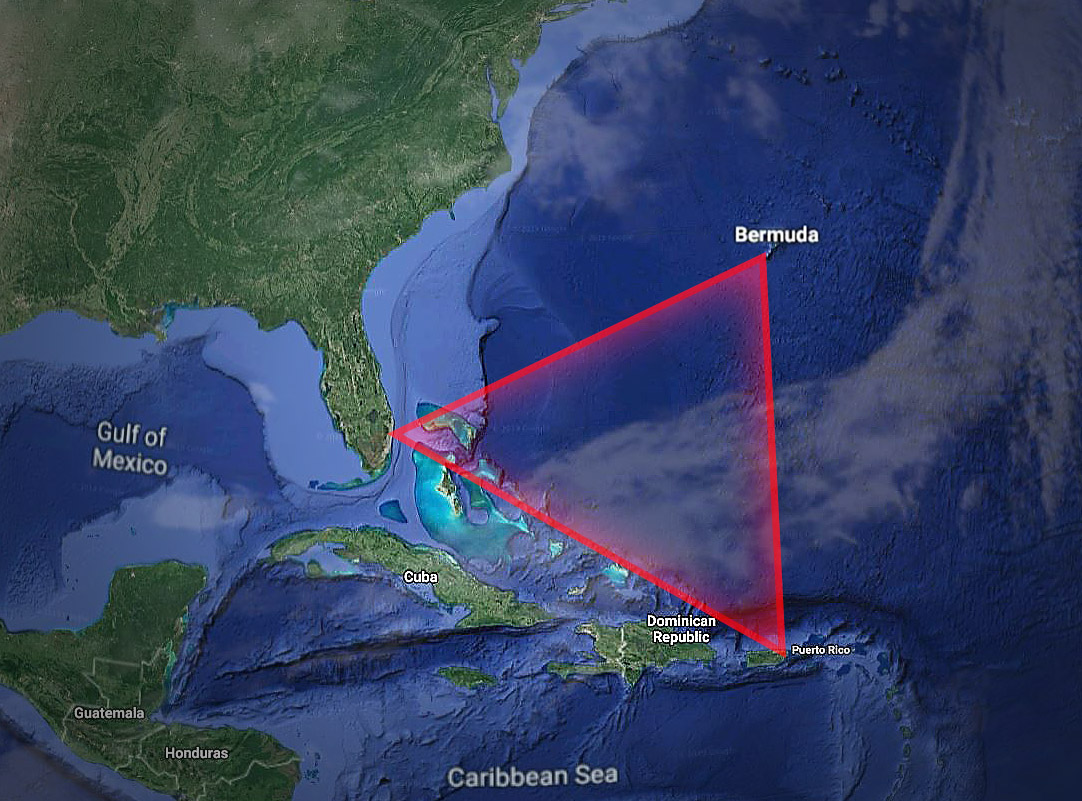
The area loosely defined by the bounds joining Bermuda, Puerto Rico, and Miami constitutes the triangle, where many a mysterious disappearance has been recorded over a century.
The most famous ship ever to vanish into the triangle is the USS Cyclops, the largest ship in the U.S. Navy in its day, which supplied fuel for the American fleet in WWI. Those who have studied the vessel have pointed out its main weakness: it was a flat-bottomed vessel and, thus, was prone to tipping. Carrying heavy cargo, the ship mysteriously vanished with 309 crew on board while voyaging from Barbados to Baltimore in 1918.
Adding
Article source: https://www.theepochtimes.com/mystery-of-the-bermuda-triangle-solved-say-researchers-conspiracy-theorists-skeptics_2927463.html
Today, what was once post-industrial urban blight – something Cleveland has an abundance of – has thousands of students passing through each year to do projects for school or intern at startups pioneering new products and seeking energetic young workers.
“It starts with a belief that with open innovation you learn the most,” said Hans Maas, director of a training center on the campus for the Rotterdam University of Applied Science.
“You share your knowledge. Your competitive advantage is that you share and that it’s not your own.”
Helen Williams, who heads education efforts of the Cleveland Foundation, was impressed with RDM when she and a Cleveland delegation visited in 2014.
“The value is the total integration of all parts of the system in one place,” Williams said. “You have the training with the opportunity to use that training in a real work situation.”
The pure joy on ten-year-old Ariene Khan’s face is unmistakable as she sits in the cockpit of a Boeing 737-800 flight simulator learning to fly the same model airplane CAL (Caribbean Airlines) operates.
The same look of joy and excitement were reflected in the faces of the other children at Professional Airline Training Solutions Ltd’s (PROATS) aviation camp held last month at Reserve Road, Trincity.
The camp was designed to introduce individuals to the world of aerospace.
Many different aspects of aviation were included in the programme such as the airplane, parts, technology, systems, the theory of flight and weather.
Besides engaging the children and allowing them to realise their aviation dreams in a fun-filled, immersive and educational environment, they learned other components as well such as self-esteem, anger management, stress relief, leadership skills, communication, teamwork, critical thinking, and problem-solving.
Ariene from Princes Town said “I want to be pilot when I grow up. Mom first saw the camp on Facebook, my older sister came to the camp and now she’s studying to be a pilot.
“I made friends at the camp, there are two other girls in class, the self-esteem programme is very inspirational. We also learned to communicate with other people, where they’re from and it definitely pushed me to the next level of being a pilot.
“If you don’t want to be a pilot and come, I’m sure you will be motivated and will want to be one as the camp
Article source: http://www.guardian.co.tt/article/k---3ids-soar-at-flight-camp-6.2.847091.e9cb2ac085
The We Company, parent company of WeWork, is the latest in a string of richly valued start-ups set to go public this year. It is valued at $47 billion, but like other newly…
Technologyread more
Article source: https://www.cnbc.com/2019/05/16/boeing-says-it-has-completed-the-development-of-updated-software-for-the-737-max.html
