Article source: http://www.startribune.com/lifestyle/travel/296726501.html
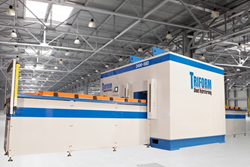
The Triform 2496-5BD fluid cell sheet hydroforming press with dual shuttles
Manufacturers currently using press brakes to form multiple bends in a single part, through several operations, will benefit from a consolidation of steps and overall manufacturing time, by transitioning those parts over to the Triform – Jeff Debus
St. Louis, MO (PRWEB) March 17, 2015
Beckwood, manufacturer of advanced hydraulic press solutions and the Triform line of aerospace focused forming machinery, is proud to announce the installation of a 24” x 96” Fluid Cell sheet hydroforming press within the aircraft manufacturing facility of a US-headquartered company.
The Triform, Model 2496-5BD, has a specific appeal to industries and operations involved with forming a variety of part sizes in low volume, high mix environments. The 2496-5BD offers a maximum of 5000 PSI of evenly distributed forming pressure which can be used to form a variety of parts using the low-cost tooling associated with the Triform process. The press is offered with either a
Article source: http://www.prweb.com/releases/2015/03/prweb12589916.htm
In America, businessmen shake hands. In Japan, they bow. But all over the world airline executives engage in a greeting that is all their own: the exchange of model airplanes.
When airlines start flying to new cities, make deals with other carriers or finance new jets, these high-quality models — typically one to two feet long — provide the perfect photo backdrop, can help break the ice or serve as a cherished “thank you.”
While a business card might be quickly stuffed away in some desk drawer, models remain prominently displayed on the desk of politicians and industry power brokers. Puerto Rico’s governor, Alejandro García-Padilla, has models from JetBlue, Lufthansa, Avianca and local airline Seaborne in his office. Each has established or expanded service to the island since his 2013 inauguration.
“It’s one of these gifts that people get and don’t put in the closet,” says Jeff Knittel, who oversees aircraft leasing for financier CIT Group Inc.
European aircraft manufacturer Airbus took in 1,456 passenger plane orders from 67 airlines around the world last year. It also placed 30,000 of its own orders — for model Airbus jets.
Multimillion dollar plane purchases are decided on the fuel efficiency of a jet, its maintenance costs, how much cargo it holds and how far it can fly. However, desktop models help start the conversation, says Chris Jones, vice president of North American sales for Airbus.
“Putting a model on the table won’t sway a deal but it might get their attention,”
Article source: http://www.chicagotribune.com/news/sns-bc-us--model-planes-20150318-story.html
While you can always find next season’s most cutting-edge looks in Manhattan’s Garment District, the most futuristic outerwear in New York City wasn’t on the runways during the recent Fashion Week. Rather, it’s to be found in a small studio in Brooklyn, where an émigré Russian engineer and a U.S.-born artist are making the ultimate in bespoke couture—the space suit—into a fast-fashion product, one-size-fits-all.
Their company is called—what else?—Final Frontier Design. But before we join them in their East River atelier, we should discuss why the problem of what to wear in space has become so pressing.
We are, perhaps, on the cusp of a significant increase in the number of humans in space. The International Space Station has maintained an average population of about six since it was first inhabited in 2000, with fluctuations during crew change-overs or when China’s space station, Tiangong-1, is occupied. But in 2017, if all goes to plan, SpaceX and Boeing will become the first private companies to put people in space, and the U.S., China, and India are all mooting more manned missions in orbit and beyond. The dream of Martian colonists and asteroid miners has never seemed so
Article source: http://m.theatlantic.com/technology/archive/2015/03/a-brief-history-of-fashion-in-outer-space/388039/
Green shoots finally are popping up in the entry-level light jet market, after the segment entered a nosedive six years ago. Now, Textron Aviation, Embraer and HondaJet, the Big Three of the light jet manufacturers, are gearing up to take advantage of better times ahead with three distinctively different models, all priced at close to $4.5 million when comparably equipped.
The competition in the entry-level jet segment never has been tougher. New models from the Big Three not only vie with each other, but they also potentially compete against hundreds of used light jets on the market that boast higher cruise speeds, longer ranges and larger cabins.
Embraer, though, has created a special niche with its Phenom 100, as it has the largest cabin cross-section, best fuel efficiency and lowest price of any entry-level light jet in current production at a Big Three manufacturer.
The Phenom 100E, starting at serial number 325, is the latest iteration. It has been refreshed with several upgrades, including multifunction spoilers, 11 standard interior motifs, wood veneers for the cabinets and many more options, to make it more attractive to buyers. It also has Embraer’s latest upgrades to the Prodigy flight deck, using Garmin G1000 avionics, and the most capable brake-by-wire software yet developed for the aircraft.
Most entry-level light jets are designed primarily for owner operators. This one is just as nice for the passengers. The aircraft sits relatively high on its
Article source: http://aviationweek.com/bca/pilot-report-embraer-phenom-100e
While you can always find next season’s most cutting-edge looks in Manhattan’s Garment District, the most futuristic outerwear in New York City wasn’t on the runways during the recent Fashion Week.
Rather, it’s to be found in a small studio in Brooklyn, where an émigré Russian engineer and a US-born artist are making the ultimate in bespoke couture—the space suit—into a fast-fashion product, one-size-fits-all.
Their company is called—what else?—Final Frontier Design. But before we join them in their East River atelier, we should discuss why the problem of what to wear in space has become so pressing.
We are, perhaps, on the cusp of a significant increase in the number of humans in space. The International Space Station has maintained an average population of about six since it was first inhabited in 2000, with fluctuations during crew change-overs or when China’s space station, Tiangong-1, is occupied. But in 2017, if all goes to plan, SpaceX and Boeing will become the first private companies to put people in space, and the US, China and India are all mooting more manned missions in orbit and beyond. The dream of Martian colonists and asteroid miners has never seemed so close to reality.
“I can pretty much assure you that there are going to be people bringing people with money to space, and they’ll have to wear something,” says Nicholas de Monchaux, an architect who wrote a history of the Apollo space suit.
That something won’t typically be the outfit you might remember from the film Gravity or those grainy videos of Apollo astronauts cavorting on the moon—white, boxy, radiation-resistant, armored against micro-meteoroids and equipped
Article source: http://www.nextgov.com/emerging-tech/2015/03/space-suit-you-could-be-wearing-few-years-now-being-designed-small-workshop-brooklyn/107733/