 The technology for 3-D printing, also known as additive manufacturing, has existed in some form since the 1980s. However, the technology has not been capable enough or cost-effective for most end-product or high-volume commercial manufacturing. Expectations are running high that these shortcomings are about to change.
Several technology trends are feeding these expectations. An emerging class of mid-level 3-D printers is starting to offer many highend system features in a desktop form factor at lower price points. Printer speeds are increasing across the product spectrum; at least one high-end system under development could print up to 500 times faster than today’s top machines. And key patents are about to expire, a development likely to hasten the pace of innovation.
In a recent PwC survey of more than 100 industrial manufacturers, two-thirds were already using 3-D printing. (See Figure 1.)
Figure 1: Prototyping has driven the adoption of 3-D printing so far. Future opportunities 3D printers chiefly used for prototyping
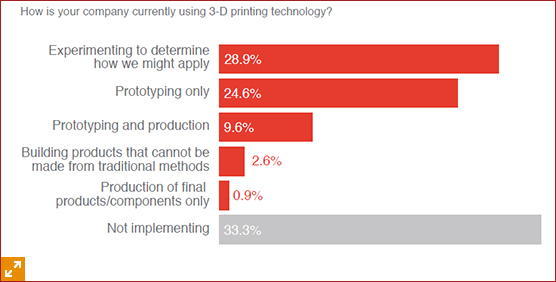
Most were just experimenting or using it only for rapid prototyping, which has been 3-D printing’s center of gravity for most of its history. Canalys, a market research firm, anticipates changes ahead and predicts the global market for 3-D printers and services will grow from $2.5 billion in 2013 to $16.2 billion in 2018, a CAGR of 45.7 percent.1
Despite these trends, the 3-D printing industry faces
Article source: http://www.engineering.com/3DPrinting/3DPrintingArticles/ArticleID/8687/The-Road-Ahead-for-3D-Printing.aspx